Kokonut Intelligence, all of accounting AI at the fiduciary office
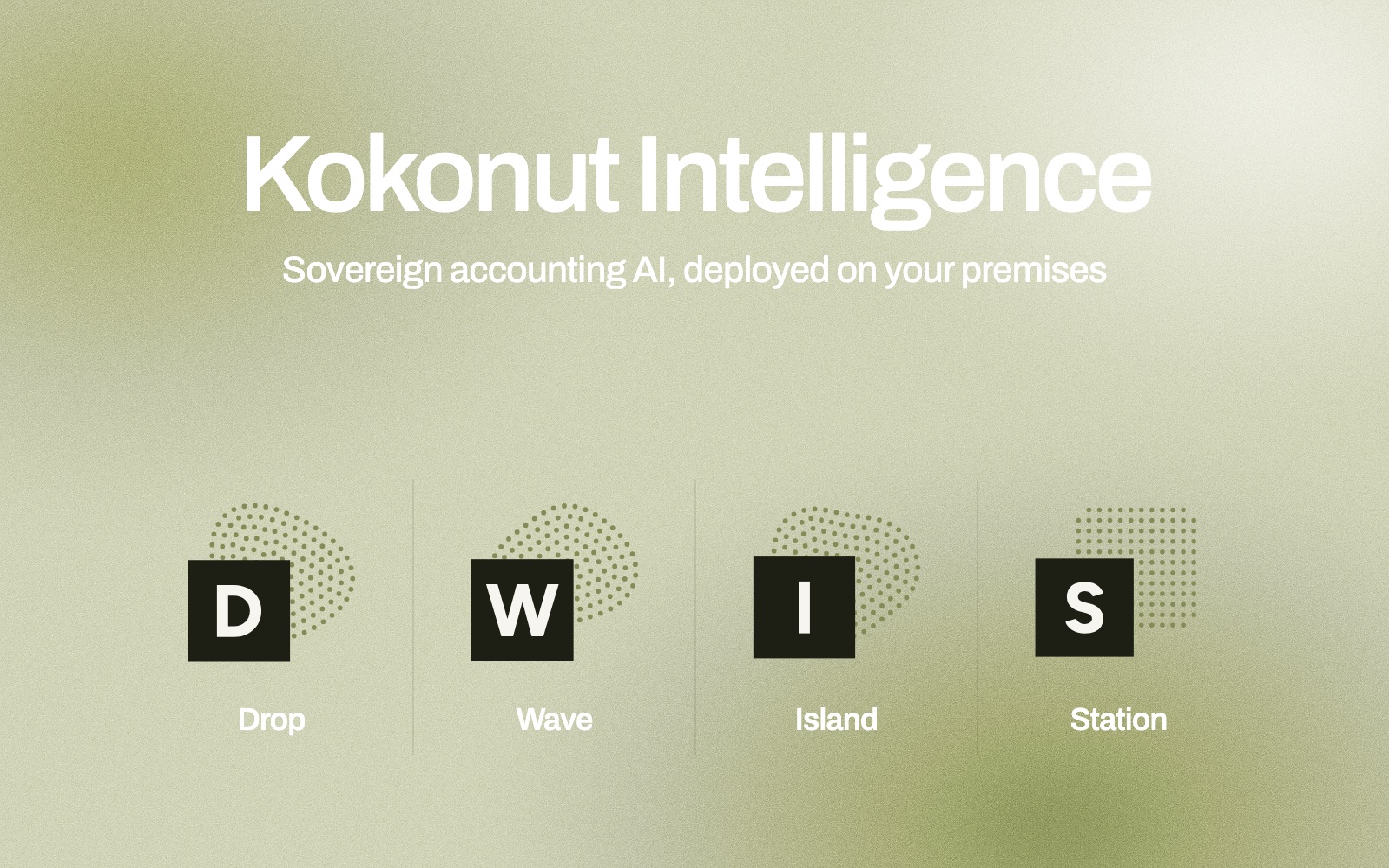
The client profile, the standardisation, the inference engine, the models and the machine. With Kokonut Intelligence, the whole value chain of accounting AI moves into the fiduciary firm, so that its data and its clients' data stay within its walls.
Accounting AI entered fiduciary offices through the cloud. You send a document, an answer comes back, and in between, a client's data has travelled to a provider you do not always get to choose. For a profession bound by confidentiality, that is a hard compromise to accept.
FYSK has always been our starting point, so that our clients get this sovereignty even in the cloud.
But Kokonut Intelligence goes even further: documents should not have to go to the AI, the AI should come to you. Available from 02.01.2027, it brings together everything needed to turn an accounting document into an entry, right on your premises.
Sovereignty first
The vast majority of accounting AI solutions on the market rent their AI today, most often from the GAFAM. We chose the opposite path, that of total sovereignty, and our whole architecture follows from it. With Kokonut Station, documents are read and posted on site:
- nothing leaves the fiduciary office: no outgoing connection during processing;
- internet is only used to install and update;
- neither documents nor answers are kept in the logs;
- a network outage stops nothing.
The models themselves, FYSK O and FYSK C, are trained in Delémont, for Swiss accounting. You no longer depend on an AI provider paid per document, nor on its terms, nor on its availability.
The whole value chain, on your premises
The market offers links: a model here, a document reading service there, an accounting software further along. It is up to you to put them together, and to accept that your documents travel from one to the next. Kokonut is today the only solution on the market offering the whole value chain of AI on premises:
| Link | Product | Role |
|---|---|---|
| The client context | Kokonut Drop | Creates the accounting profile of the client file, the .kdf file |
| Standardisation | Kokonut Wave | Pre-processes each document and standardises the entry |
| The inference engine | Kokonut Island | Runs the FYSK models offline |
| The models | FYSK O and FYSK C | Read the document, then classify it and write the entry |
| The machine | Kokonut Station | Runs it all on your premises, without internet |
| The software | Kokonut Fid | Receives the entry in the client file, ready to approve |
Each link is designed for the next one. That is what makes a stable and consistent result possible.
The journey of a document
Let us follow one document: a telecom invoice of CHF 248.60, dropped into the file of Menuiserie des Franches SA, a fictitious client.
1. The client profile
Kokonut Drop sums up what the fiduciary office knows about the company (chart of accounts, accounting history, supporting documents) in a single file, the Kokonut Drop File (.kdf). It is the accounting context of the client, made understandable for the AI. If you use Kokonut Fid, this file is generated in one click and Kokonut Drop is then not needed.
2. Standardisation
Kokonut Wave loads this profile, pre-processes the invoice and sends it to the AI. Its promise fits in one sentence: for a given company, the same entry, whatever the AI. To do so, Kokonut Wave passes the company profile to the AI. The AI no longer works blind: it posts according to the company's habits.
3. Reading and posting, offline
On Kokonut Station, Kokonut Island takes over. FYSK O reads the invoice and returns its content as structured data: supplier, number, date, amounts and VAT. FYSK C then does the accounting classification and writes the entry, based on the client profile:
| Account | Debit | Credit |
|---|---|---|
| 6510 Telephone, internet | 229.97 | |
| 1170 Input VAT | 18.63 | |
| 2000 Payables | 248.60 |
On an NVIDIA DGX Spark, we measured 3200 documents processed per hour.
4. The entry, in your software
With Kokonut Fid, the entry lands in the client file, ready to approve. Without Fid, it goes to your accounting software, if it is compatible. If it is not, Kokonut Fid can export the entries for your software. In every case, you are the one who approves.
With or without Kokonut Fid
Kokonut Intelligence does not force you to change tools:
- You use Kokonut Fid: the client profile is generated from Fid, and the entries come back into the client file. Fid then feeds your accounting software, as it does today.
- You do not use Kokonut Fid: Kokonut Drop creates the profile, and the entries reach your software if it is compatible. To find out, ask its publisher whether it integrates our SDKs; if not, Kokonut Fid bridges the gap.
Kokonut Station or your own hardware
Kokonut Station is the turnkey option: a single machine, on your desk or in your server cabinet, running Kokonut Wave, Kokonut Island, FYSK O and FYSK C without internet. Once plugged in, it runs on its own, plug & play.
Already have your own infrastructure? Kokonut Island is also available under licence, on your own hardware: a single NVIDIA graphics card is enough and only needs 14 GB of graphics memory.
Kokonut Wave can also work in the cloud, with the AI of your choice. It is an option, not an obligation: sovereignty remains your choice.
FYSK Agent, to handle a whole period
Kokonut Intelligence turns a document into an entry. FYSK Agent, the accounting agent built into Kokonut Fid, works at the scale of a whole period, from the statement to the review. We followed it on a sample client file in Delegating a period to FYSK Agent, from drop to review.
Available from 02.01.2027
Kokonut Drop, Kokonut Wave, Kokonut Island and Kokonut Station are available from 02.01.2027. And to see where all this is heading, read our vision of accounting by 2028.
Kokonut Intelligence, two ways
The journey of a document, with or without Kokonut Fid, and the four products in detail.
The FYSK models on fysk.ai
FYSK O, FYSK C, each product and the SDKs for publishers.